An arteriovenous malformation (AVM) can sit quietly inside the brain for thirty or forty years without producing a single symptom, then suddenly it can turn your whole world upside down. The annual hemorrhage risk for an untreated brain AVM is roughly 2% to 4%. Catching one early and learning about your different treatment options can mean the difference between a planned approach and an emergency room.
While most conversations about AVMs focus on the brain because a bleed there can cause a hemorrhagic stroke, these snarled clusters of blood vessels also form in the spinal cord, lungs, and other parts of the body.
Read on to learn about the four main treatment paths available today, how to know which treatment is the right treatment for you, and where to find the best brain surgeon in Los Angeles for AVMs.
Understanding Arteriovenous Malformations
An AVM is a tangled group of arteries that drain directly into veins, skipping the tiny capillaries that normally cushion the flow and pass oxygen to surrounding tissue. That fast, high-pressure detour gradually thins vessel walls and raises the chance of a rupture.
Most AVMs are present at birth, even though the people who have one often go decades without knowing. When symptoms do show up, they can be vague or mimic other neurological conditions. Some of the first symptoms often include:
- A sudden, splitting headache
- Seizures
- Developing recurring headaches in the same location
- One-sided weakness, similar to a stroke
- Sudden trouble with speech, vision, or balance
The most serious symptoms present as a hemorrhagic stroke. This can happen when the malformation finally bleeds into surrounding tissue.
How are AVMs Diagnosed?
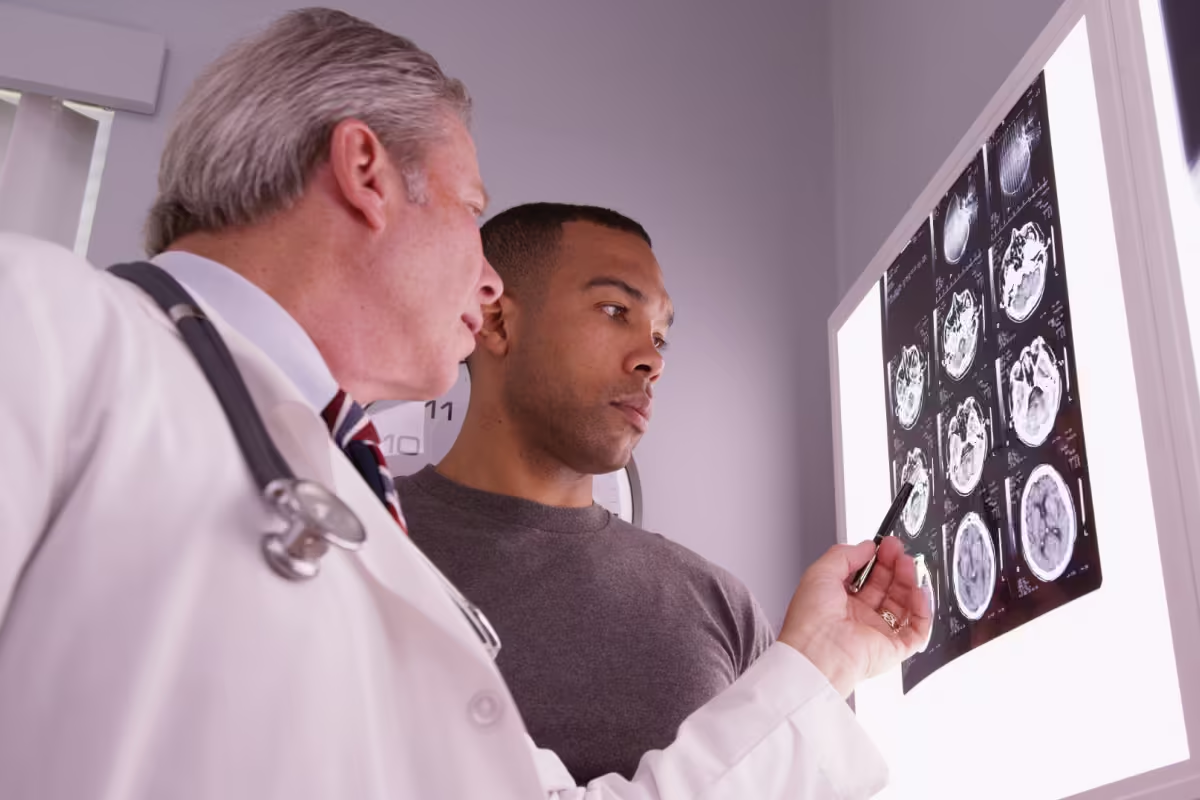
Confirming an AVM usually starts with getting an MRI or a CT angiogram, both of which can show the tangle and be used to roughly estimate its size. The most detailed test is a cerebral angiogram, a procedure that threads a thin catheter through the blood vessels and injects dye to map every feeding artery and draining vein.
What Are the Treatment Options for an Arteriovenous Malformation?
There are four main treatment options that the best brain surgeon in Los Angeles will consider when treating an AVM:
- Microsurgery: This treatment involves opening the skull and physically removing the tangle of blood vessels.
- Endovascular Embolization: This treatment uses a catheter to deliver a glue-like material that blocks blood flow into the malformation.
- Stereotactic Radiosurgery: This uses a focused beam of radiation that causes the abnormal vessels to scar shut over time.
- Observation: This approach involves tracking the AVM with regular imaging and treating any symptoms with medication.
To decide which treatment fits, the best brain surgeon in Los Angeles relies on the Spetzler-Martin scale, a grading system from one to five that weighs the AVM's size, how close it sits to critical brain areas controlling movement or speech, and whether its drainage runs deep or near the surface. A higher grade signals higher surgical risk.
Because every grade and location requires different expertise, the best arteriovenous malformation treatment in Los Angeles involves seeing a top neurosurgeon and sometimes involves interventional neuroradiologists, radiation oncologists, and neurologists in the same room to plan together.
When Is Open Brain Surgery the Answer for Arteriovenous Malformation?
Microsurgery is the most direct way to cure an AVM. After a craniotomy, the best brain surgeon in Los Angeles uses a high-powered microscope and very small instruments to find the malformation, clip off its feeding arteries one by one, and lift the tangle out of the surrounding brain. The procedure is the first-line choice for accessible Spetzler-Martin grade one or two lesions, along with many grade three lesions, where the AVM is small enough and in a safe enough spot that a clean removal is realistic.
Once the AVM is out, the rupture risk drops to zero, which is something neither embolization nor radiation can promise. The trade-off is that open brain surgery carries a risk of bleeding, stroke, and new neurological problems such as weakness, speech changes, or visual changes. Those risks rise with the AVM's grade, its location near brain regions that handle critical functions, and your age and overall health.
Endovascular Embolization for Arteriovenous Malformation: The Minimally Invasive Option
Endovascular embolization is the least invasive way to reach an AVM from inside the blood vessels. During this procedure, the team threads a thin catheter from a small puncture in the groin or wrist, up through the body, and into the brain, guided in real time by X-ray. Once the catheter sits at the edge of the malformation, the neurosurgeon injects a liquid glue, tiny coils, or fine particles to plug the abnormal vessels and cut off blood supply to the tangle.
Embolization is often the best treatment in three specific cases:
- Before microsurgery to shrink the AVM and reduce bleeding when the surgeon goes in
- Paired with radiosurgery to make high-grade lesions that cannot be safely removed smaller and easier to treat
- Partial embolization to ease symptoms by lowering the blood-flow imbalance around the malformation
A major benefit to embolization is that most patients go home within a day or two and skip the long healing window that follows open surgery. The downside is that embolization on its own rarely cures larger AVMs, and the procedure carries the same risks of any brain surgery, which can include stroke, vessel injury, or hemorrhage.
Finding the Best Brain Surgeon in Los Angeles for Arteriovenous Malformation Treatment
AVMs are a complicated condition that requires expert surgical guidance. At California Neurosurgical Specialists, Dr. Benet leads an expert team who see and treat AVMs daily.
With clinics in Santa Barbara and Westlake Village, our team works with AVMs of every grade, from small lesions that may only need monitoring to complex cases that call for a layered plan across surgery, embolization, and radiosurgery. For those already diagnosed with an AVM and searching for the best arteriovenous malformation treatment in Los Angeles, getting a second opinion is something most specialists openly encourage, since recommendations can shift based on a team's experience with similar cases.
Ready to get the most advanced and effective treatment for AVMs with the best brain surgeon in Los Angeles?





.svg)


.svg)
.svg)